


A Grace-Filled History |
||
Grace’s beginningIn the summer of 1864 a small group of Amherst Episcopalians asked the Reverend Frederic Dan Huntington, Rector of Emmanuel Church, Boston, and summer resident of his family home in nearby Hadley (now the Porter-Phelps-Huntington Museum) to hold services for them. With the backing of the Huntington family, Grace Church was quickly organized. The first rector, the Reverend Samuel P. Parker, was called in November 1864. Services were held in the Amherst Academy on Amity Street until the congregation purchased land on the eastern edge of the Town Common. They laid the cornerstone of a chapel there on July 25, 1865.
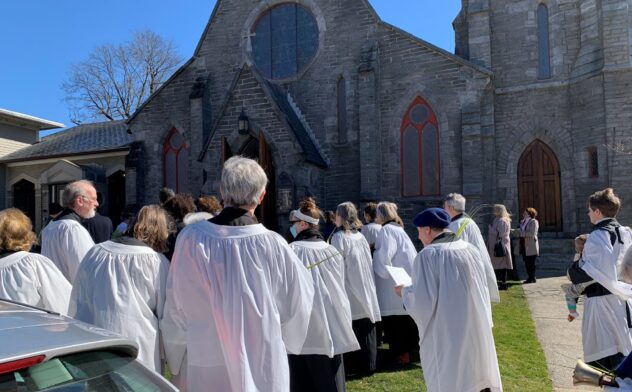
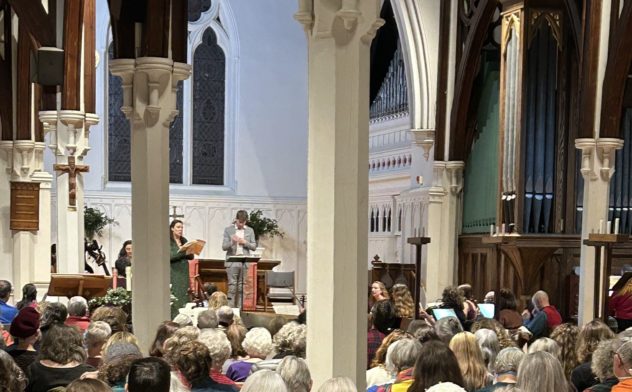
The buildingsA major figure in mid-19th century Gothic Revival church design in America, English émigré Henry Dudley designed the Gothic Revival stone structure, modeling it after medieval Oxford churches. His use of gneiss from Pelham accords with his ecclesiological principle of clear and honest use of materials. On March 2, 1866 the first service was held in the church and on July 17 the building was consecrated by the Bishop of Massachusetts. The Bell Tower was added in 1868 and the adjacent colonial house was purchased in 1870, serving first as a rectory and later as offices. An apartment was added to the Old Rectory in 1982.
In 1915, the Parish House was built at the rear of the property on Spring Street; it now features newly renovated Sunday School rooms, choir practice spaces and an inviting fireplace room for meetings. The building has been named for beloved parishioner, Priscilla C. Parke, in 2003. In 1956, the Parish Hall was added to the structure and has also been redesigned in 2003 with partitions, new lighting and carpeting. In 1972, a Connector was built between the church and the Old Rectory: it now serves as meeting space for committees and commissions, houses the library and is a favorite location for Sunday coffee hours and other social gatherings.
OutsideA columbarium, where ashes of deceased parishioners reside, was constructed in 1982. Tucked within the buildings, the Garth is a lovely place for quiet meditation and church picnics.
|
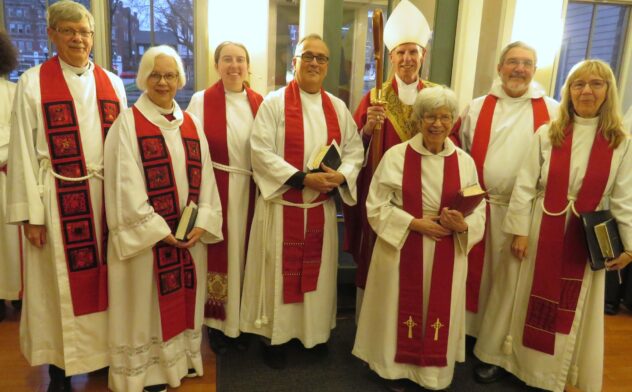
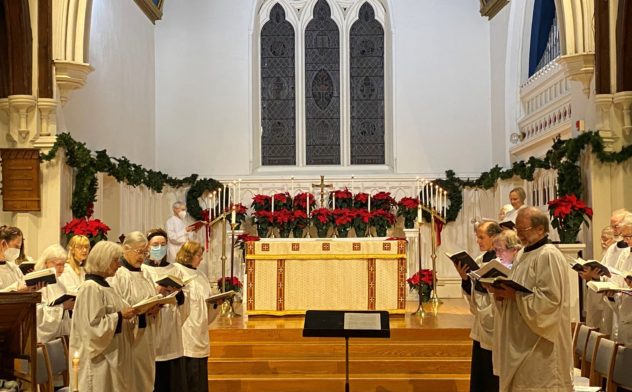
PeopleSince Grace Church was first organized, seventeen rectors, fourteen curates (assistants), three associate priests, and two interim priests have served the parish. Several went on to become bishops and deans of seminaries. Starting in 1883 with the Reverend Samuel Snelling, who taught Greek at Amherst College, many of Grace’s clergy served as chaplains and occasional athletic coaches at the College, which maintained a close relationship with the parish. In 1960 Amherst College appointed its own chaplain, and with the expansion of the University of Massachusetts, the appointment of an Episcopal chaplain there, and the growth of the town, the parish has been much less identified with the College. By the mid-1970's Grace Church had a dynamic identity that led to a dramatic increase in membership and a rich program of education, worship, and music including a bell choir, canon trumpeter, two choirs, courses taught by both clergy and laity, and an expanded schedule of services RenovationSNoted authority on liturgy, Canon Edward West of the Cathedral of St. John the Divine in New York, recommended a number of interior alterations in the 1970s. Wooden fleur-de-lis that ornamented the pews were removed, and the lower halves of the pillars were painted to simulate stone. The altar was moved back from the east wall. The choir has sung from several locations and a new mechanical action organ replaced the original one. In recent years, the great stonework of Grace Church received much needed attention, the Bell Tower was rebuilt and its bell replaced. In the downstairs Chapel, termite damage required the installation of new non-wood support pillars. In 2004, Grace Church began a Restoration Project..
The windowsAs you leave, please note the large circular window depicting St. Michael and All Angels. The Archangel Michael triumphs over evil in this gift from Edwin van Etten, former Dean of the Cathedral of St. Paul in Boston. The large window in the east wall, behind the altar, is a veritable encyclopedia of religious symbols. The dove is prominent because Grace is a gift of the Holy Spirit. Figures in small round medallions in each corner symbolize the four evangelists. The Hebrew letters spell Yahweh. Atop a north side window a pelican pierces her breast to feed her young, symbolizing the Atonement. Several windows on the side walls are in memory of old Amherst families. In this way we are reminded that a church is not just a building but a place that is sanctified by the lives of the people who have worshipped there.
|
|